

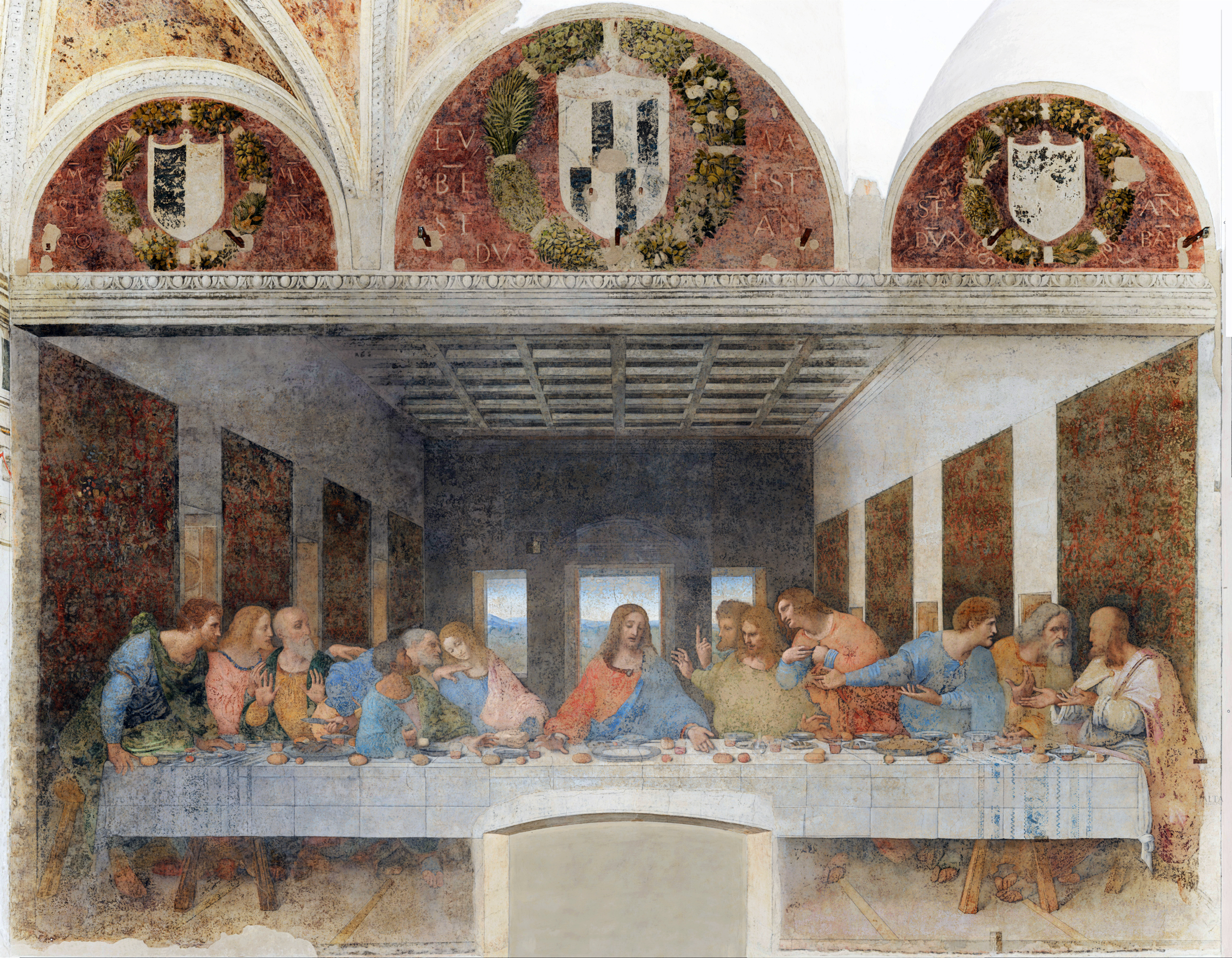
The Last Supper (Cenacolo Vinciano) by Leonardo da Vinci is one of the world's most renowned paintings. Created between 1494 and 1498 under the patronage of Ludovico il Moro, the Duke of Milan, this iconic artwork depicts the final meal shared by Jesus and his disciples.
Leonardo da Vinci invested a great deal of effort and research into creating this masterpiece, producing numerous preparatory sketches. Departing from the traditional fresco method, he chose to paint “dry” on the refectory wall of the Convent of Santa Maria delle Grazie. This innovative technique allowed Leonardo to incorporate intricate details, evidenced by traces of gold and silver foil discovered in the painting, which aimed to enhance the realism and preciousness of the figures.
However, this approach, combined with environmental factors, led to the rapid deterioration of the fresco. Over the centuries, The Last Supper has undergone numerous restoration efforts to preserve its integrity. The most recent and significant restoration was completed in 1999, employing advanced scientific methods to recover the original colors as accurately as possible and to remove previous restoration attempts that had altered the fresco.
This meticulous restoration has allowed modern audiences to appreciate Leonardo’s genius and the intricate details he envisioned, ensuring that The Last Supper continues to be a testament to Renaissance art and an invaluable cultural treasure.
The Importance of The Last Supper Painting
The Last Supper holds significant importance in Christianity, art history, and Milan’s cultural identity. Created by Leonardo da Vinci in the late 15th century, this masterpiece is celebrated for its extraordinary art techniques and its evocative emotional narrative. Despite enduring over 500 years and surviving numerous catastrophes, it remains a cornerstone of Milan's cultural heritage.
In art history, The Last Supper is revered for Leonardo's innovative use of perspective, composition, and human emotion. It represents a pivotal moment in Christian theology with a representation of the dramatic scene of Jesus announcing his betrayal during the final meal with his disciples. This powerful depiction has influenced countless artists and remains a profound subject of study and admiration.
In the realm of tourism, The Last Supper serves as a magnet for art lovers visiting Italy. Its profound impact mirrors the way La Dolce Vita celebrates the timeless beauty of Italian culture. Together, these experiences remind us how art and travel intertwine to feed the soul.
You can also explore paintings inspired by France and Italy in our Travel Destinations Collection, a perfect way to bring a touch of European artistry into your own creative journey.
Facts You Didn’t Know About Da Vinci’s Last Supper
Leonardo da Vinci’s The Last Supper is one of the most admired, studied, and replicated paintings in the world. Located in the refectory of the Convent of Santa Maria delle Grazie in Milan, Italy, this masterpiece harbors many secrets and intriguing facts that even seasoned art enthusiasts might overlook.
Innovative Technique
Da Vinci experimented with materials on The Last Supper. Instead of using the traditional fresco technique (painting on wet plaster), he used dry plaster, a method also known as secco. This allowed him more time for details but made the work less durable.
Deterioration and Restoration
The painting began deteriorating within a few years due to the experimental method and environmental factors. Its most recent major restoration, completed in 1999, took 21 years to accomplish.
Hidden Musical Notes
In 2007, Italian musician Giovanni Maria Pala suggested that by mapping the positions of bread and hands, one could read musical notes across the composition — forming a haunting melody when played.
Mathematical Symmetry
Da Vinci structured The Last Supper around mathematical principles of symmetry and proportion much like the balance and harmony celebrated in our by other Famous Paintings and Their Hidden Meanings.
Apostolic Expressions
Da Vinci captured the charged moment when Jesus announces his betrayal. Each apostle reacts differently between disbelief to anger to sorrow in a masterclass in emotional storytelling.
Judas’s Isolation
Unlike other depictions, Da Vinci subtly integrated Judas into the group. His shadowed face and bag of silver mark him, yet he’s not visually exiled and is a reflection of Da Vinci’s nuanced psychology.
Theories and Myths
Some authors have speculated that the figure beside Jesus is Mary Magdalene, not the apostle John in a theory popularized in fiction but dismissed by scholars.
War Damage
During World War II, Allied bombs struck the convent, but The Last Supper survived thanks to protective sandbags which is a near miracle that preserved this treasure for future generations.
Cultural Impact
The painting has influenced countless works, from religious art to modern pop culture. Its cultural power is as enduring as the legacies explored in The Most Famous Male Painters in Art History, a lineage that Leonardo helped define.
After so many years, The Last Supper continues to fascinate and inspire, drawing visitors, scholars, and creatives alike. It’s a reminder that art like travel, creativity, and painting itself connects us across centuries.
If this masterpiece sparks your wanderlust, take a virtual art-inspired journey with our Travel Destinations Collection featuring pieces inspired by travels.